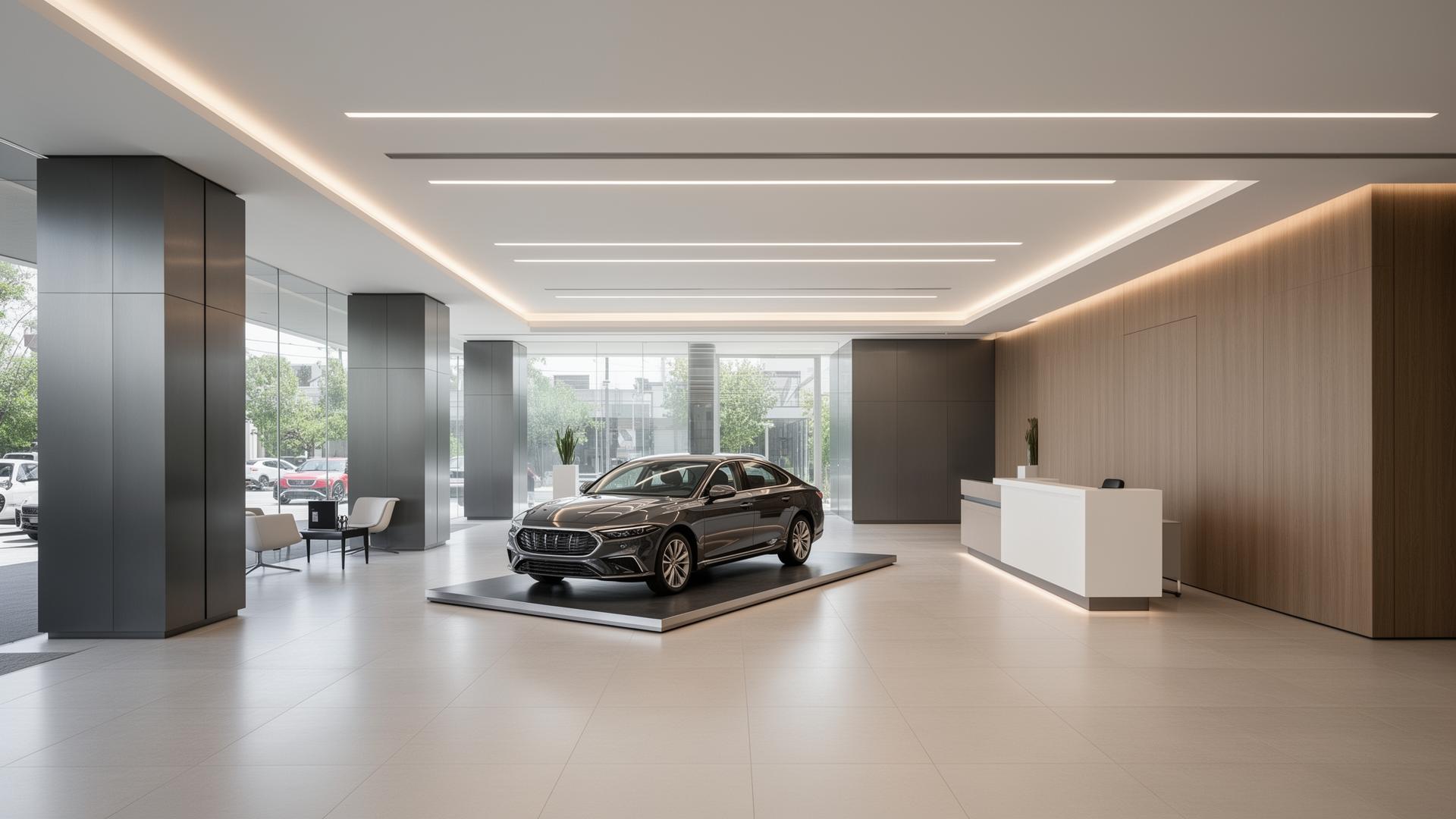
Some follow very strict global guidelines. Others adapt their spaces to the local market. Some prioritize a premium experience, while others focus on efficiency, commercial visibility or a more technology-driven journey.
In every case, the challenge is the same: turning a brand identity into a functional, well-executed and consistent physical space for the customer.
The foundation of every strategy: brand guidelines
An effective visual implementation strategy starts with brand guidelines.
These guidelines define how visual identity should be applied in different contexts: colors, materials, typography, furniture, signage, lighting, consultation areas, displays, screens and customer circulation inside the showroom.
In an automotive showroom, guidelines are not only an aesthetic document. They serve as a control tool to ensure that every touchpoint communicates the same brand image.
When properly defined, they help prevent improvisation and support more consistent execution across different dealerships, agencies or points of sale.
Why can each brand have a different strategy?
Although many brands share similar objectives, each one may apply a different strategy depending on its positioning, origin, dealer network and commercial model.
A premium brand does not need to communicate the same message as a volume brand. A brand focused on electric vehicles may require more technology-oriented spaces. A large dealer network may need more standardized guidelines to maintain consistency across different cities.
This is why visual implementation depends on several factors:
- brand positioning;
- target customer profile;
- dealer network structure;
- showroom size and format;
- implementation budget;
- allowed level of customization;
- launches, campaigns or new models;
- global standards and local adaptation.
The important point is that visual identity should not remain a concept. It must be executed correctly in the real space.
Common visual implementation models
In Mexico, showroom strategies may vary, but they often follow a few general models.
Global implementation with local adaptation
Many brands work with global guidelines that are later adapted to the Mexican market. This helps maintain international consistency while considering local conditions such as available spaces, suppliers, regulations, materials or installation timelines.
Centralized implementation
Some brands seek a high level of control from headquarters or a regional office. In these cases, showrooms usually follow stricter rules to preserve a uniform image.
Implementation with local suppliers
In other cases, execution depends on local teams, architects, manufacturers or installers. This option can improve response time and market adaptation, but it requires clear control to avoid visual deviations.
Implementation by showroom type
Not all spaces play the same role. A flagship showroom, a traditional dealership, a temporary space or a display zone inside another retail environment may require different solutions.
Guidelines and adaptation to the Mexican market
Local adaptation is a delicate part of the process. Adapting does not mean improvising.
In an automotive showroom, a brand may need to adjust materials, dimensions, installation systems, furniture or space distribution. But those adjustments must respect the original visual identity.
Adaptation should solve real issues:
- material availability;
- site conditions;
- production timelines;
- logistics;
- regulations;
- maintenance;
- budget;
- customer experience.
A strong visual implementation balances the global standard with the operational reality of the Mexican market.
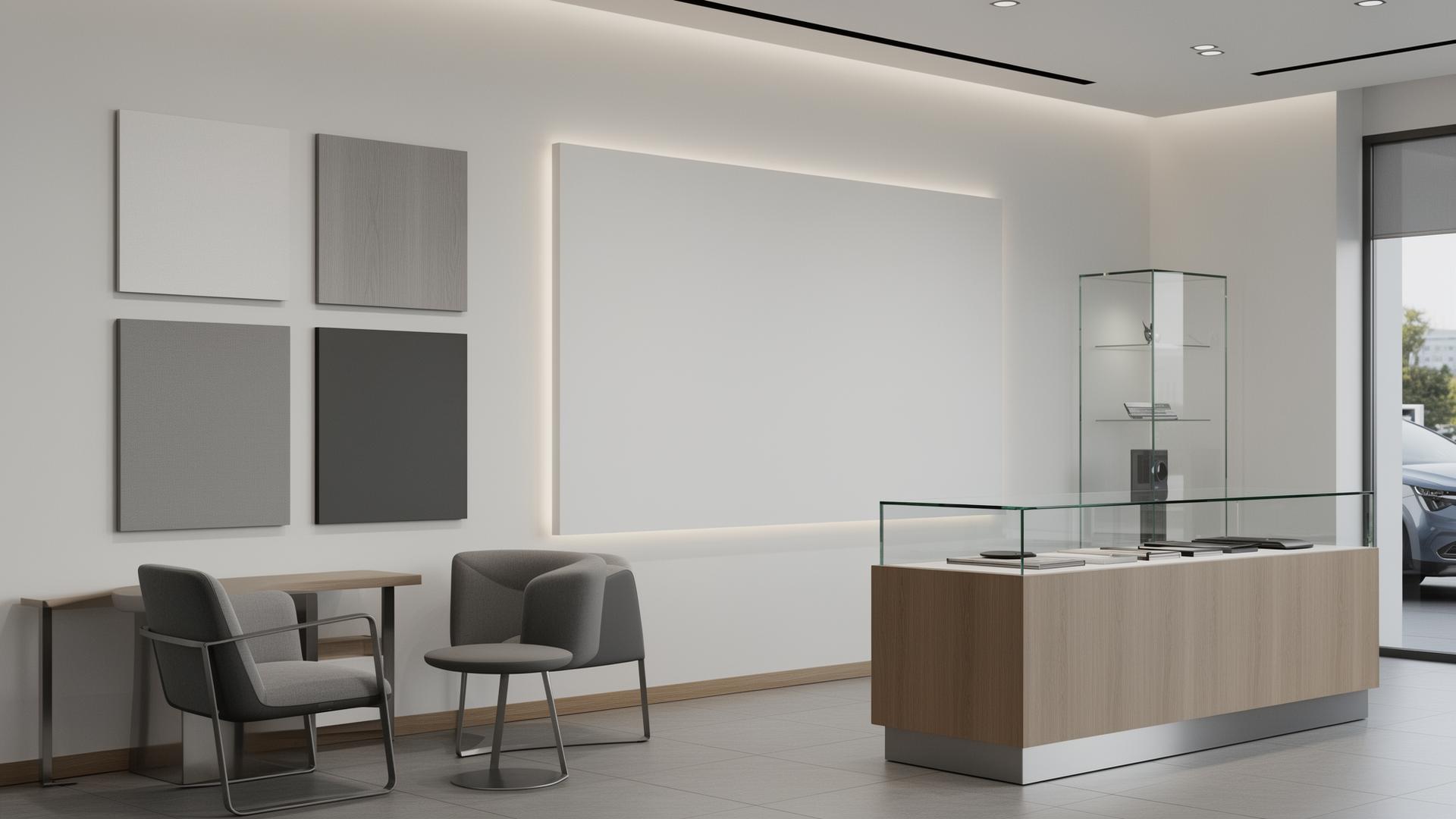
Elements that define the showroom experience
Visual identity is perceived through multiple physical and digital elements.
The most important ones include:
- customer service furniture;
- desks, counters and consultation tables;
- waiting areas;
- vehicle display areas;
- accessory showcases;
- material and finish samples;
- internal signage;
- campaign graphics;
- digital screens;
- lighting;
- customer circulation;
- delivery, service or consultation zones.
Each element must have a clear function. If the showroom is filled with objects without hierarchy, the experience becomes confusing. If the space is well structured, the customer understands the brand, the product and the journey more easily.
The role of commercial furniture
Commercial furniture is a central part of visual implementation.
It does more than organize the space. It also influences how customers perceive brand quality, interact with the sales team and explore products, accessories or materials.
In an automotive showroom, furniture may include:
- reception areas;
- consultation tables;
- counters;
- showcases;
- sample displays;
- lounge areas;
- accessory displays;
- digital stations;
- information modules.
To work well, furniture must be consistent with guidelines, resistant to daily use, comfortable for the team and adapted to the customer journey.
Technology and digital integration
Technology is increasingly visible in automotive showrooms.
Screens, configurators, digital kiosks, audiovisual content or interactive tools can help explain models, versions, finishes and services.
But technology should not be integrated only to look modern. It must serve a specific function within the customer journey.
A poorly placed screen, unclear content or an unused device can weaken the experience. By contrast, well-integrated digital tools can reinforce brand identity and support purchase decisions.
Production, installation and execution control
A visual strategy can be well designed and still fail if production or installation does not meet the same standard.
Physical implementation requires coordination between design, manufacturing, logistics, installation and final review. Every material, piece of furniture, graphic element and lighting point must follow the same standard.
The most common issues often appear when there is not enough control over:
- measurements;
- finishes;
- materials;
- alignment with guidelines;
- installation quality;
- maintenance;
- consistency between showroom areas.
This is why execution is as important as strategy. A showroom is not judged only by the idea, but by the installed result.
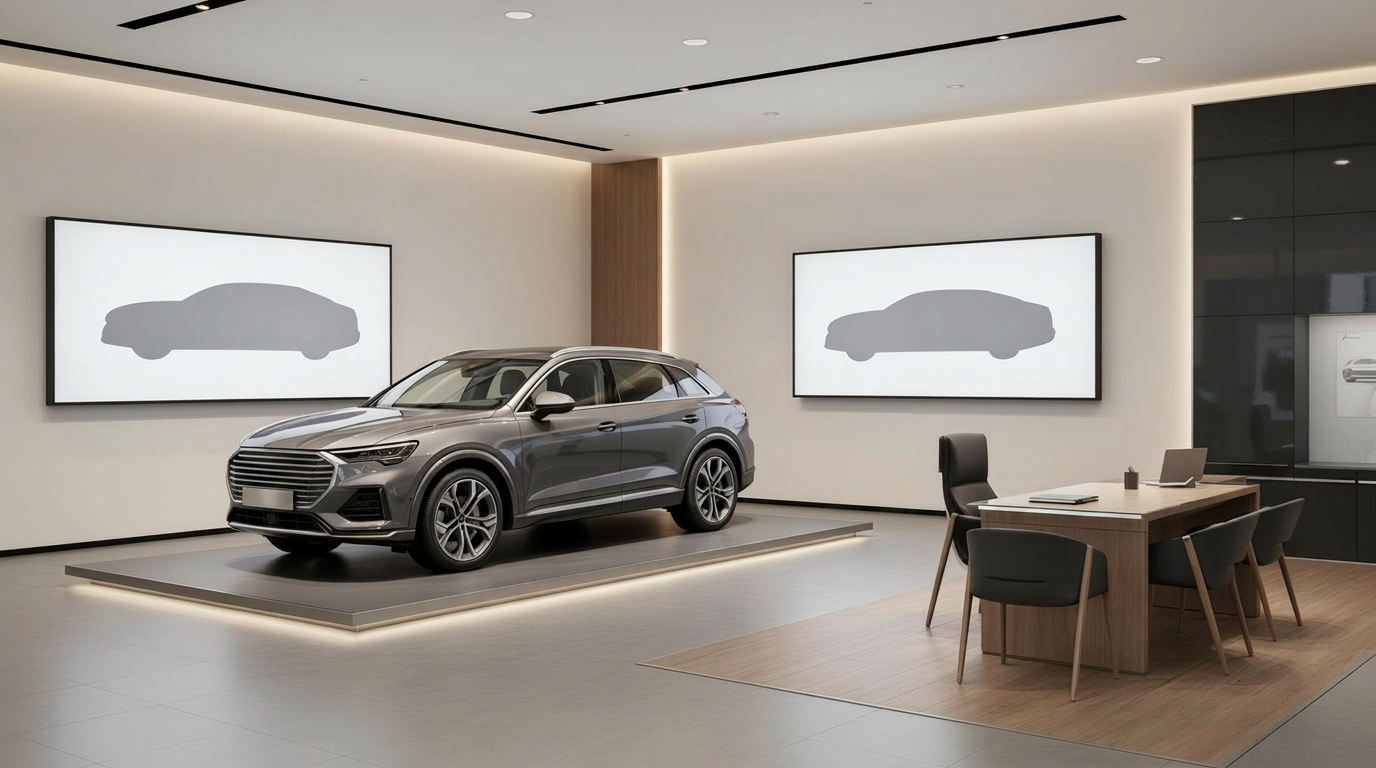
How to measure visual implementation
Visual implementation can be assessed through several criteria.
Useful indicators include:
- consistency with guidelines;
- clarity of the customer journey;
- perceived quality of the space;
- ease of interaction with products and advisors;
- time spent in the showroom;
- customer satisfaction;
- visibility of models, accessories or services;
- maintenance of physical elements;
- consistency across different points of sale.
These indicators help determine whether the showroom truly supports its commercial purpose and not only its aesthetic role.
Conclusion
Each automotive brand may follow a different visual implementation strategy, but they all share one need: turning brand identity into a coherent, functional and well-executed physical space.
Guidelines, commercial furniture, signage, technology, materials and installation must work under the same logic. When that happens, the showroom stops being only a place of display and becomes a clearer, more effective brand experience.
At MRB, we understand visual implementation as an integrated process: design, production, furniture, installation and execution control to create more consistent and commercially useful retail spaces.